What Specialized Materials and Design Features Are Critical for Wind Turbine Carbon Brushes to Withstand Extreme Conditions?
The integrity and efficiency of global renewable energy generation rely heavily on a small but critical component: the Wind Turbine Carbon Brushes. These components are indispensable for transmitting electrical current and signals across the rotating interfaces within a wind turbine: specifically, the main generator and the pitch control system slip rings. Unlike stationary industrial equipment, wind turbines operate under relentless mechanical stress, fluctuating loads, and highly dynamic environmental factors including extreme temperatures, from freezing cold to intense heat, and high-altitude atmospheric variability. Therefore, Carbon brushes for wind turbines must be engineered with specialized materials and sophisticated designs to ensure reliable conductivity, stable generator performance, and long-lasting durability in demanding renewable energy applications.
The Material Science of Generator Carbon Brushes:
For the main generator, these generators can range from synchronous to doubly-fed induction generators, the carbon brushes must handle substantial current densities while consistently maintaining an optimal protective film on the slip rings. This interfacial film is crucial for minimizing friction and wear and must remain stable across wide temperature and humidity swings. Top-tier Wind Turbine Carbon Brushes Manufacturers typically employ highly customized grades for these critical tasks:
Electrographitic Grades with Specialized Impregnation: These grades are frequently favored for many generator applications due to their inherent high mechanical strength and excellent commutation properties. For wind turbines, the electrographite is often impregnated with chemical additives, such as metal sulfides or halides, to actively stabilize the wear rate. This stabilization is particularly critical in low-humidity, high-altitude environments where the natural lubricating properties of graphite can diminish rapidly. This specialized impregnation process is essential; it ensures stable generator performance and actively prevents catastrophic wear and tear during prolonged dry operational periods.
Copper-Graphite Grades: While traditionally utilized for high-current requirements in industrial motors, a CG component may also be necessary in larger generators, though its use is sometimes restricted to specific phases or excitation circuits due to the need for lower friction. The engineering challenge involves carefully balancing the need for high current transfer capacity with managing the increased abrasiveness inherent in the copper content. Advanced CG grades specifically developed for wind applications incorporate a finer particle distribution to significantly reduce commutator or slip ring wear, thus extending the component’s operational life.
Metal-Impregnated High-Altitude Grades: For turbines situated in very cold, dry climates, which are common in many new wind farms and mountain installations, brushes containing a tailored metal content, such as silver, are absolutely essential. The inclusion of metal provides an inherent lubricating quality and helps maintain an extremely stable contact resistance even when the protective film layer on the slip ring is thin or compromised. This stability ensures the reliable conductivity needed for consistent and efficient power output.
The comprehensive selection process is governed by the specific slip ring material, for example, brass, bronze, or steel, and the overall generator design, demonstrating precisely why Wind Turbine Carbon Brushes Suppliers should offer extensive and expert technical consultation.
Specialized Brushes for the Pitch Control System
Beyond the critical main generator application, a secondary and equally vital application is found in the pitch control system. This system utilizes dedicated slip rings and Carbon brushes for wind turbines to safely transfer sensitive control signals and necessary electrical power from the stationary nacelle hub to the rotating blade root. This transfer capability allows for precise blade angle adjustment, known as pitch, which is necessary for optimal aerodynamic performance, load management, and emergency safety stops.
|
Brush Application
|
Material Requirement
|
Key Performance Metric
|
|
Main Generator
|
Specialized Electrographite / Metal-Graphite
|
High Current Density, Low Friction, Stable Film
|
|
Pitch System
|
Silver-Graphite Grades
|
Low Noise, Ultra-Low Contact Resistance, High Reliability of Signal
|
|
Grounding / Lightning
|
Copper-Graphite / Pure Copper
|
Extremely High Momentary Current Capacity for Safety
|
For the pitch system, Silver-Graphite Grades are often mandatory due to their exceptional properties. These grades purposefully contain a percentage of silver, which contributes the lowest possible contact resistance. This low resistance is crucial for accurately and safely transmitting sensitive control signals, such as those governing precise pitch angle adjustments, without any undue electrical noise or signal degradation. Maintaining this precision and signal integrity is fundamentally important to the long-lasting durability of the entire turbine system, as inaccurate pitch control can rapidly lead to dangerous over-speed conditions or serious structural damage.
Design Elements for Operational Stability:
The structural design of the brush itself, as well as the accompanying brush holder mechanism, carries equal importance to the material composition, especially given the constant rotational movement and high levels of vibration present within the turbine nacelle.
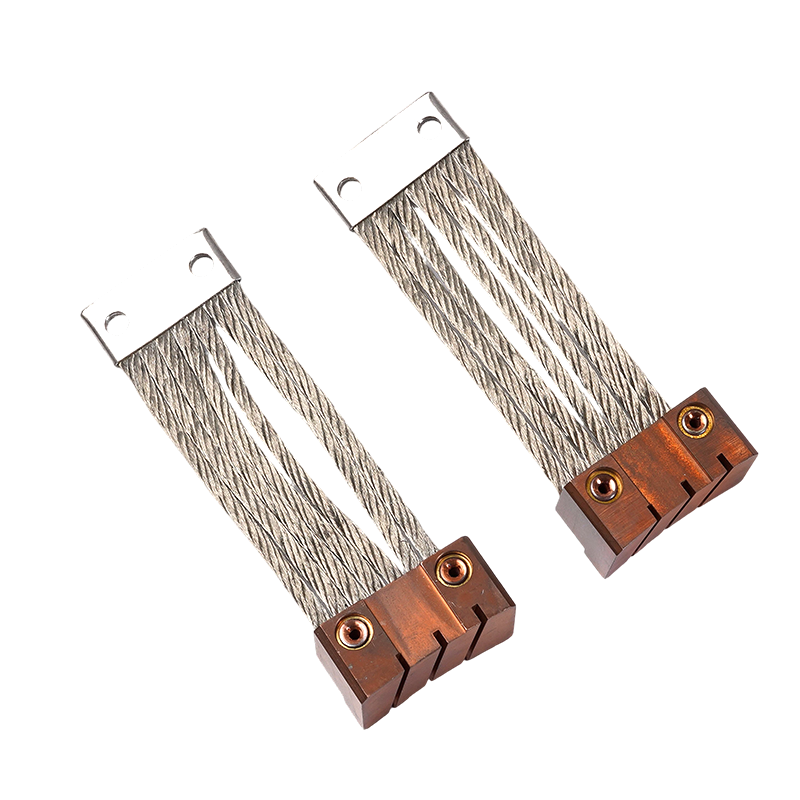
Pigtail and Connection Integrity: The pigtail, or shunt, which connects the brush block to the terminal, must be constructed to be ultra-robust. In wind applications, these connections must withstand years of continuous low-frequency, high-amplitude vibration stress. High-quality Wind Turbine Carbon Brushes Manufacturers therefore utilize high-strand-count copper wires and highly specialized crimping or welding techniques to ensure extremely low-resistance connections that are inherently resistant to fatigue and thermal cycling over the long term.
Constant Force and Pressure Control: Brush tension must be regulated by advanced constant-force springs. Given that turbines frequently operate unattended for many months, these springs must be engineered to maintain optimal and consistent pressure across the brush face throughout the brush's entire wear life. Incorrect tension inevitably leads to catastrophic failure: too little tension causes arcing and severe sparking, while too much pressure causes excessive wear and heat generation.
Segmented and Multi-Brush Configurations: Large wind turbine generators often utilize multiple small brushes per slip ring track or employ segmented brushes. This design approach significantly enhances overall contact reliability, as individual segments can effectively maintain contact even if the slip ring surface is slightly imperfect. Furthermore, this configuration improves both cooling efficiency and current distribution, thereby ensuring stable generator performance.
How Do Digital Manufacturing and Global Certifications Ensure Supply Chain Reliability for Wind Turbine Carbon Brushes?
The ability of Wind Turbine Carbon Brushes Suppliers to consistently meet the complex and non-negotiable requirements of the renewable energy sector is predicated on superior manufacturing precision, uncompromising quality control, and digitally managed supply chain operations. Producing a high-volume component like the Wind Turbine Carbon Brush while adhering to the extreme performance standards of global turbine OEMs requires a systematic approach to production scaling and quality management.
Manufacturing Scale and Digital Process Control:
Crucially, Jiangsu Hailing Carbon Products Co., Ltd. utilizes advanced digital tools to master this complexity. The company's internal adoption of an advanced ERP system provides a systematic and measurable advantage in the precision manufacturing of Carbon brushes for wind turbines. This ERP system functions as the primary backbone of their operational excellence, enabling the following specific advantages:
Raw Material Purity and Traceability: The system comprehensively tracks specialized raw material blends, including silver content and binder type, from initial procurement through final product formation. This granular traceability is vital for the wind sector, where performance variation between batches is utterly unacceptable. It ensures full-process quality control and enables rapid root-cause analysis should any field issue arise.
Lean Management for Inventory and Delivery: The ERP actively facilitates lean management practices, optimizing the complex production flow which includes pressing, firing, final machining, and pigtail attachment. By providing real-time visibility into inventory and production capacity, it ensures competitive lead times for Wind Turbine Carbon Brushes Suppliers. This speed is a critical factor in the time-sensitive turbine maintenance and repair cycle.
Customization and Specification Control: Wind turbines necessitate the use of highly specific brushes across different models and core components, such as the generator, pitch system, and grounding. The advanced ERP system efficiently manages the thousands of unique product specifications, ensuring that custom orders, often required for older turbine models, are manufactured and delivered precisely according to the exact engineering drawings.
Product Validation and Global Quality Standards:
The reliability claim for Wind Turbine Carbon Brushes Manufacturers must be fully backed by both rigorous internal testing procedures and strict adherence to global quality and environmental mandates.
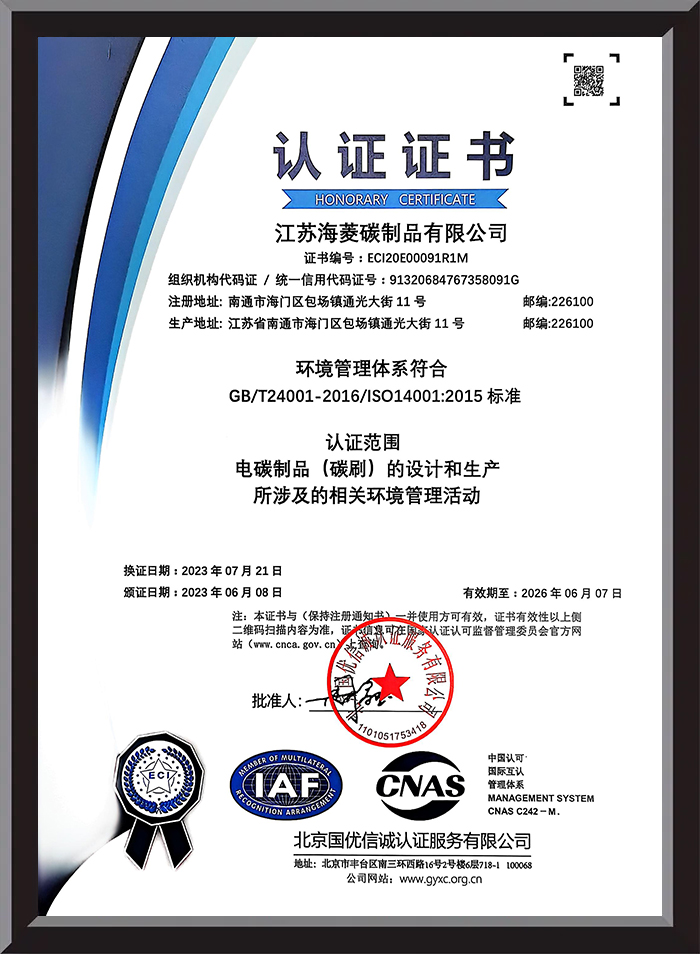
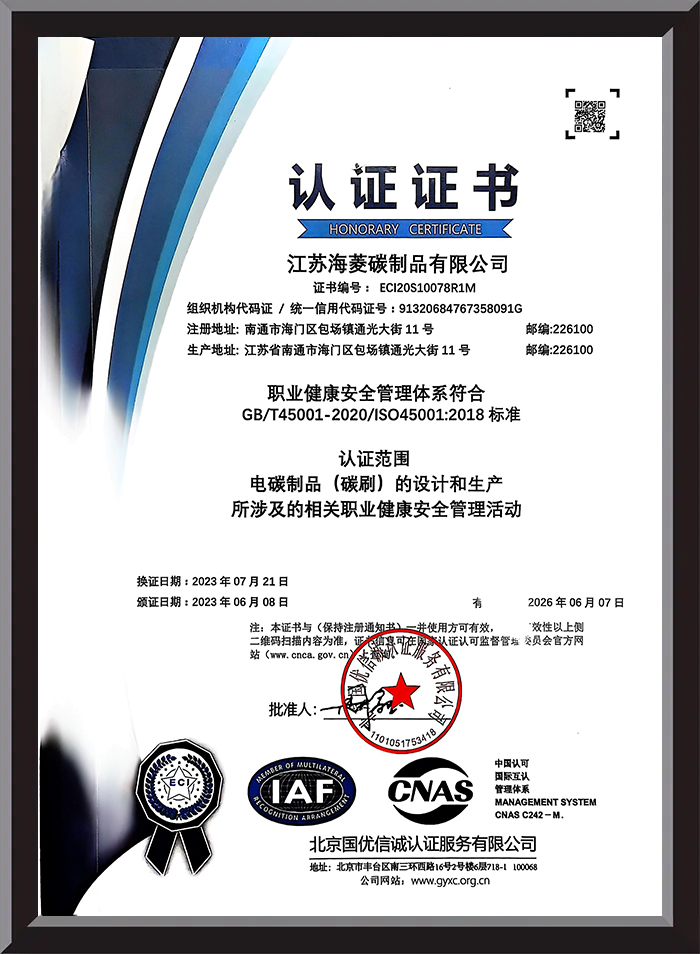
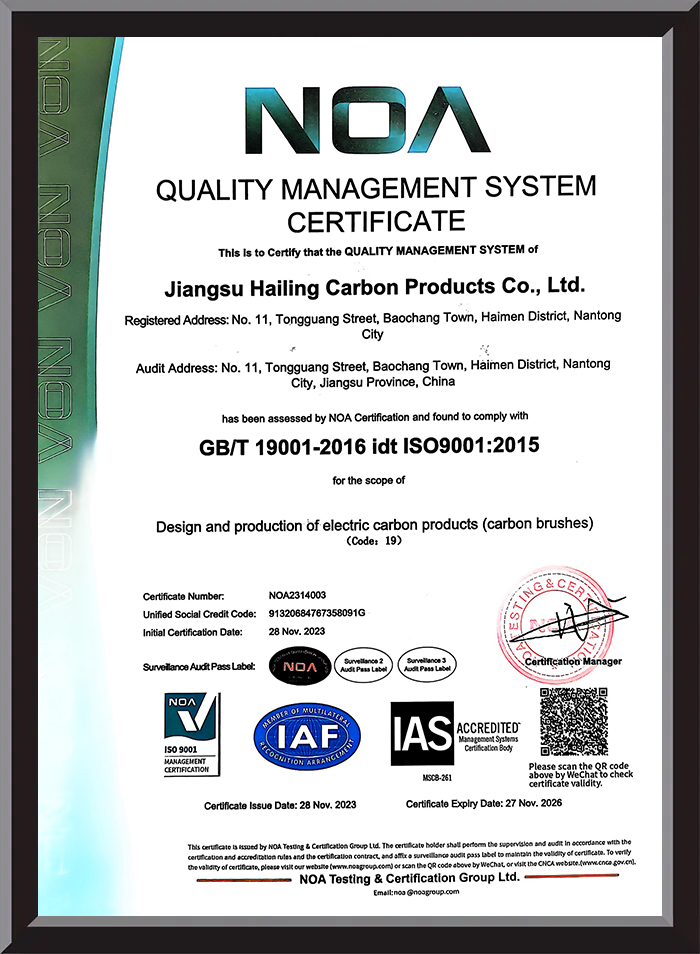
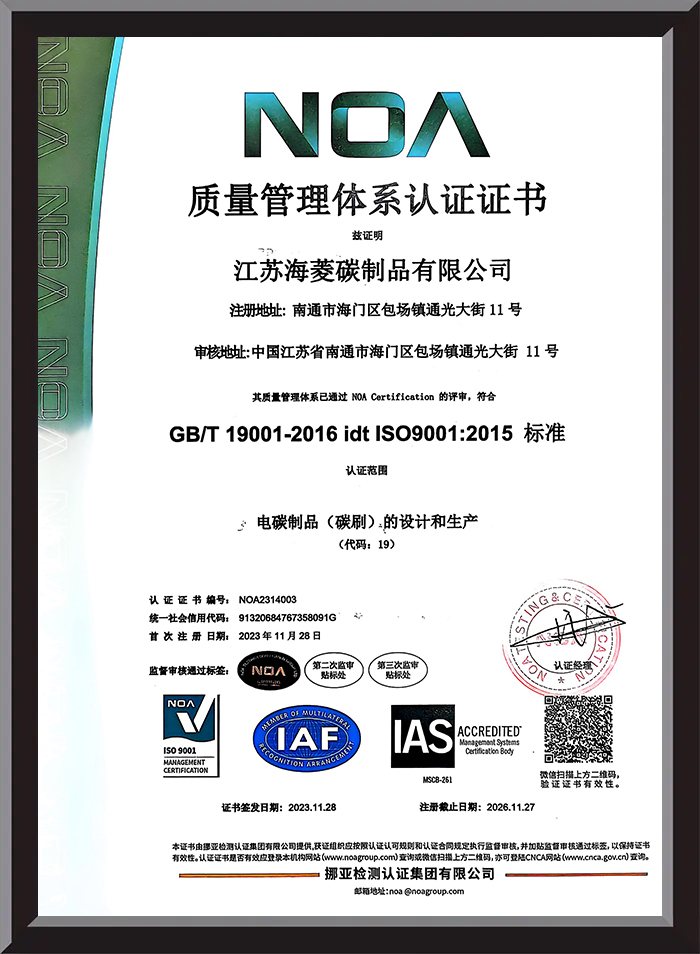
Environmental and Reliability Certifications: The manufacturer adheres to comprehensive international standards. Following ISO 9001 for full-process quality control establishes the foundational quality management framework. Furthermore, holding ISO 14001 for environmental management and ISO 45001 for occupational health and safety ensures responsible, sustainable, and safe manufacturing practices are maintained consistently.
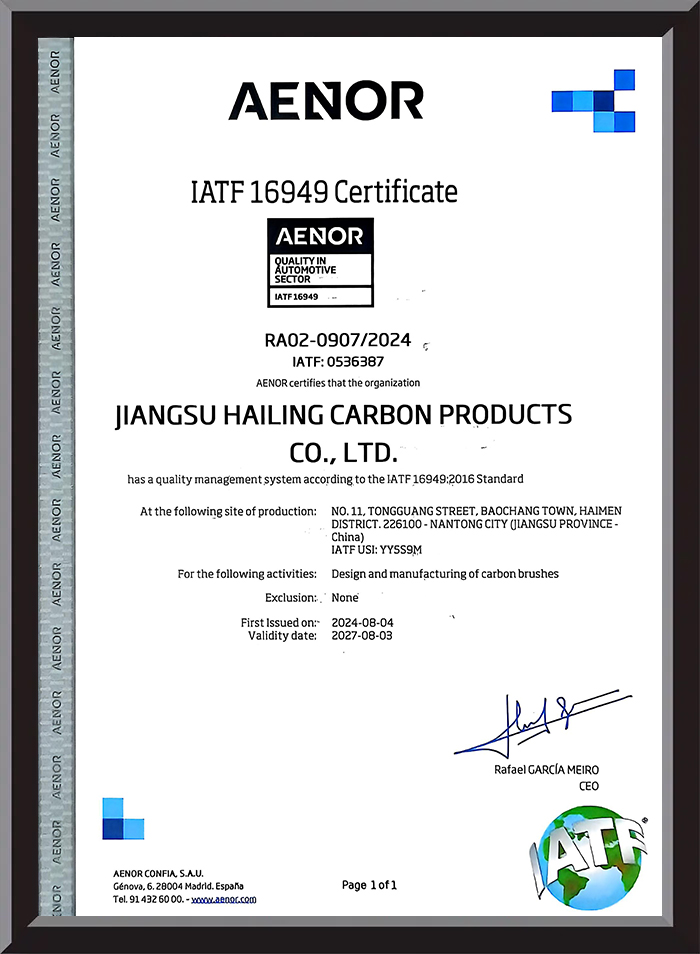
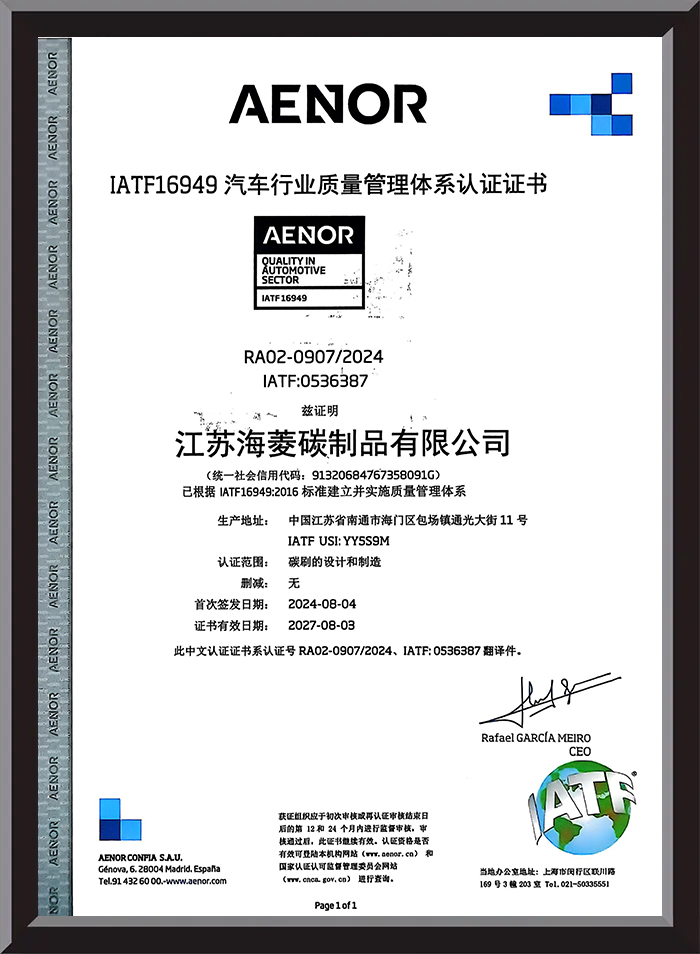
Automotive-Grade Quality System IATF 16949: The possession of the IATF 16949 certification, which is recognized globally, signifies an explicit commitment to the most demanding quality standards for component supply chain management. This includes rigorous processes for risk reduction, a zero-defect mentality, and stringent change control. This elevated quality benchmark is highly valued by wind turbine OEMs who operate with similarly high reliability and safety expectations in their long-term assets.
Dynamic and Environmental Testing:
Beyond mere certifications, high-quality Wind Turbine Carbon Brushes must undergo specific and demanding testing designed to accurately simulate the hostile operating environment:
Vibration Testing: Brushes and holders are intentionally subjected to the extreme vibration profiles experienced in the nacelle to confirm contact stability and pigtail resilience under real-world mechanical stress.
Cold Start / Low Humidity Testing: Specialized climate chambers are used to replicate high-altitude, low-humidity conditions. This test confirms the brush’s ability to correctly form and maintain its protective film, directly guaranteeing long-lasting durability in demanding renewable energy applications.
Brand Strength and Innovation for Future Energy:
The manufacturer maintains a strong and continuous focus on the refinement of its product portfolio and technological innovation. This forward-looking approach ensures that the Wind Turbine Carbon Brushes are continually adapted to meet the demands of newer, more powerful generator technologies and stricter maintenance schedules required by the rapidly evolving renewable energy sector.
This combined focus on certified quality management, sophisticated digital production management, and decisive technical leadership allows these leading Wind Turbine Carbon Brushes Suppliers to serve as dependable and strategic partners in the rapidly expanding global renewable energy sector, ensuring that the core electrical interface components are consistently high-performance and compliant with the toughest standards required for stable generator performance.


 English
 中文简体
中文简体