Oct 29, 2026
"How are brushes made?" Ask a painter and you will hear about bristles and ferrules. Ask a hairstylist and you will hear about cushioned pads and handles. But ask us, and the answer involves carbon, graphite, furnaces and precision machining. At Jiangsu Hailing Carbon Products, we have spent more than 20 years manufacturing carbon brushes for electric motors, so we would like to walk you through the real production process, stage by stage, and explain what each step does to the final product.
Before we dive into the details, here is a quick overview of the process on our production floor.
| Stage | What happens | What matters most |
|---|---|---|
| Material selection | Carbon, graphite, metal powders and binders are weighed and blended | Formulation balance |
| Pressing | The mixture is compacted in precision molds into a brush blank | Uniform density |
| Sintering | The blank is baked in a controlled furnace atmosphere | Temperature profile |
| Machining | Sintered material is cut, ground and drilled to final dimensions | Tolerances and surface finish |
| Assembly | Shunt wires, springs and terminals are fitted to the brush body | Precise positioning |
| Testing | Dimensions, resistance and motor performance are verified | Consistency |
Every carbon brush begins with a recipe. The base materials include natural graphite, synthetic graphite, carbon black, metal powders such as copper, and binding agents like coal tar pitch or thermosetting resin. The proportions control hardness, electrical conductivity, contact drop and wear rate, so the formulation has to match the motor it will serve. A brush designed for a high-speed angle grinder behaves differently from one made for a forklift motor, even though both contain the same basic ingredients.
This is one of the places where experience matters. Over the years, we have built a library of proven grades and learned which ones hold up under real working conditions. For a deeper look at how these grades are classified, our guide to carbon brush grades explains the material selection logic in everyday terms.
Once the formulation is fixed, the powders are carefully weighed and blended with the binding agent, rather like mixing a very dense dough. The mixture then goes into a precision mold and is compacted under high pressure. Depending on the material system, the process may be cold pressing followed by a separate curing operation, or hot pressing, which combines forming and curing in one step.
The part that comes out, sometimes called a green compact, already has the rough shape of a brush. It is still porous and fairly fragile, and it needs the next stage to become a solid working component.
The green compact now moves into a furnace. Sintering, also called baking or roasting in our industry, is carried out at temperatures that often reach or exceed 1000°C under a carefully controlled atmosphere. During this stage the binder carbonizes and fuses the carbon structure together. For metal-graphite brushes, fine copper particles bond with the graphite at this point, creating the combination of strength and electrical performance that these materials are known for.
Small differences in the heating profile can noticeably change the final properties. That is why our operators monitor each furnace cycle closely, and why we still rely on knowledge that is hard to put into a manual: knowing how a batch will react takes years of experience.
A carbon brush only does its job if it fits its motor correctly. After sintering, the material is cut and ground to exact dimensions. For many applications, tolerances are measured in hundredths of a millimeter. This is also when we machine the chamfers and bevels that help the brush contact the commutator smoothly, and when we drill the holes for wires and slots for springs.
The finish of the contact face matters just as much as the size. A clean, consistent surface reduces sparking and keeps current transfer stable, which protects both the brush and the commutator over the long term.
Most carbon brushes do not work as a bare block; they are part of a complete assembly. A copper shunt is attached to the brush body by riveting, soldering or embedding, and then the spring and terminal are fitted to the specific design. Every element has to be positioned with care. An off-center wire or a spring with the wrong tension changes the contact pressure, and that can shorten the service life of the brush dramatically.
No brush leaves our factory without passing inspection. Under our ISO 9001-based quality system, and with certifications that include IATF 16949 for automotive applications, every production batch is checked for:
Samples are also mounted on real motor test rigs, where we verify commutation, sparking and brush wear under load. This level of testing matters across every product family. Whether it is a small brush for a household vacuum cleaner or a rugged unit for wind turbines and industrial robots, the motor cannot perform better than the brush inside it.
Because every motor has its own working conditions, we tune both the material and the geometry to the application rather than relying on a one-size-fits-all product.
Electric power tools, for instance, place heavy demands on the brush. High speeds, vibration and frequent start-stop cycles call for a formulation that maintains stable conductivity without wearing too quickly.
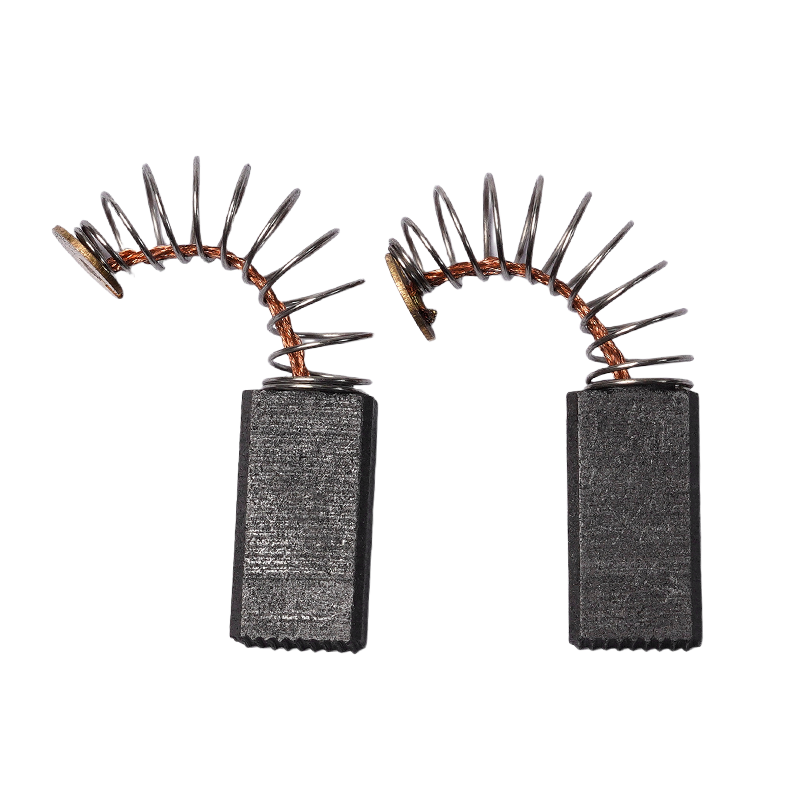 Power Tool Carbon Brushes Built for High-Demand MotorsThis category covers brush models engineered for power tools, offering steady conductivity and wear resistance under vibration, high speeds, and frequent start-stop cycles.View Product →
Household appliances form another interesting world. A washing machine or vacuum cleaner motor runs for long periods, often in dusty and warm surroundings, so brushes for these applications favor longer service life, low sparking and consistent performance over months of use.
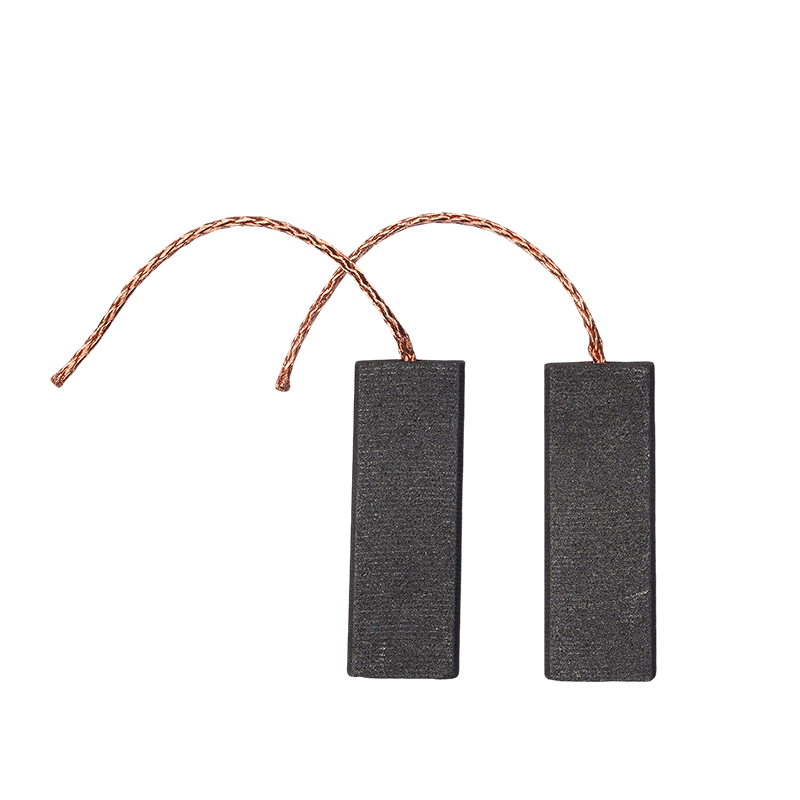 Household Appliance Carbon Brushes for Reliable, Quiet MotorsExplore brushes for washing machines, vacuums, treadmills, and kitchen electronics — designed for consistent performance and long service life in dusty, warm environments.View Product →
Industrial machinery takes things even further. Wind turbines, compressors, robots and logistics equipment often run continuously, and replacing a brush at the wrong moment can disrupt an entire production line. In these applications, durability and predictable wear are the first priorities.
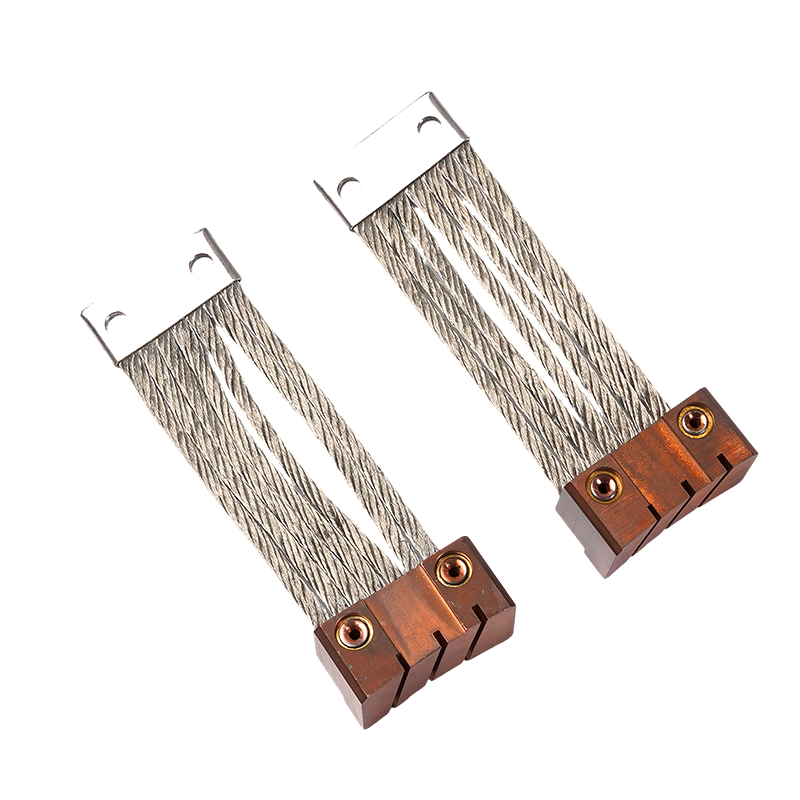 Industrial Machinery Carbon Brushes for Continuous OperationThese brushes suit wind turbines, compressors, and robots, prioritizing durability and predictable wear to avoid downtime in round-the-clock industrial applications.View Product →
The honest answer is that it depends on the brush. But when it comes to carbon brushes, the process is a careful balance of material science, mechanical precision and quality control. From the first batch of powder to the final motor test, every step exists for a reason, and skipping any of them would be noticeable in the brush's performance.
We hope this look inside our production floor gives you a clearer picture of what goes into a quality carbon brush. If you are choosing replacement parts or developing a new motor, understanding the manufacturing process makes those decisions a lot easier. And if you would like to go deeper into the working principles behind these components, our article on how carbon brushes work is a good place to continue.

Phone:
+86-183 6280 9971
+86-513 8277 2222
Email:
 Custom Motor Carbon Brushes Manufacturers


 English
 中文简体