Oct 14, 2026
An angle grinder that suddenly feels weak, throws bright sparks, or smells faintly of scorched varnish is usually telling you one thing: its carbon brushes are worn out. It is also one of the few power-tool repairs a careful owner can genuinely handle at home, and on most models it takes fifteen minutes and one screwdriver.
We have spent more than twenty years manufacturing carbon brushes for power tools, so we see this job from both sides: the brush that fails early because it was the wrong grade, and the grinder that keeps working for another decade because somebody replaced the brushes in time. Here is the process we normally walk customers through, from the first symptom to the test run.
Carbon brushes feed current into the spinning commutator, and they are deliberately made to wear away instead of damaging the motor. Grinding is a high-current, dusty job, so brush life varies enormously: a hobby user may get several hundred hours from a set, while someone cutting steel every day may wear one out in a few weeks.
Watch for a combination of these signs rather than a single one:
One symptom on its own is rarely conclusive. Two or three together, on a tool with a few hundred hours behind it, are a strong hint that the brushes are due.
Before ordering anything, look at how your grinder is built, because the access route decides how long the job takes. Most grinders fall into one of two groups.
With external brush caps, you will see a screw cap on each side of the motor housing, roughly in line with the commutator. Undo them with a coin or a flat screwdriver and the brush slides straight out, spring and all. With internal brushes, the holders sit under the housing, so you need to remove the gearbox cover or the field case to reach them. If you are not sure which design you have, the parts diagram in your manual will show it in a minute.
Brushes are always replaced in pairs, even when only one looks worn. A mismatched pair loads the commutator unevenly, and the newer brush will have worn down to match its tired partner within a few hours of use.
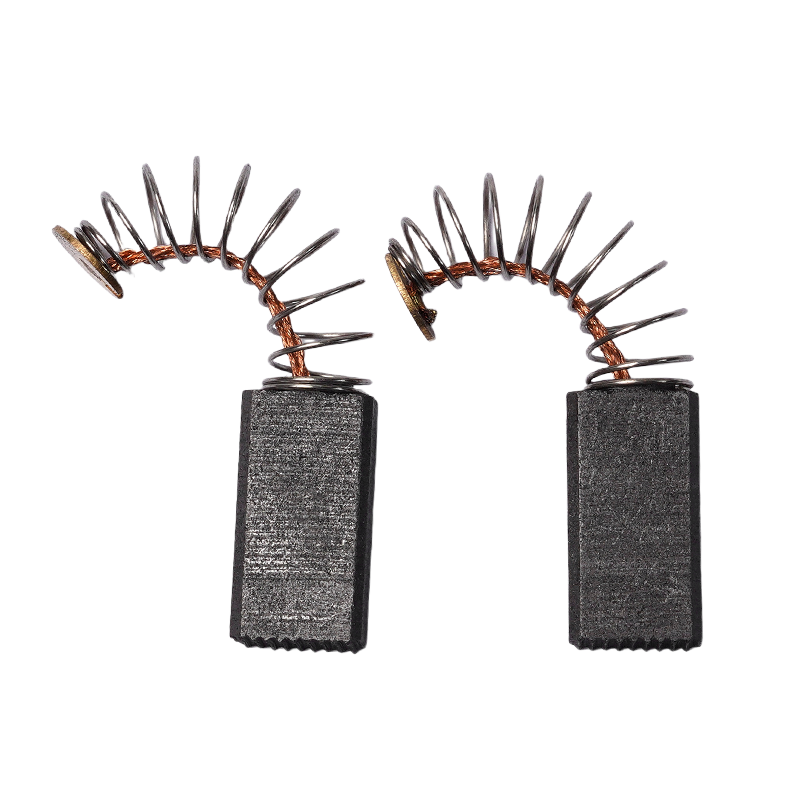 Universal Power Tool Carbon BrushesBrowse universal carbon brushes for many power tool brands, suited to paired replacement and simplified maintenance across common motor designs.View Product →
On externally accessible designs the caps sit on opposite sides of the motor housing, in line with the commutator. On internal designs you will find the holders at the end of the field coils, with each brush pressed against the commutator by a small coil spring or a flat brass pressure strip.
Unscrew the cap slowly and keep one hand under it, because the spring will push the brush forward as the thread releases. Slide the brush out of its holder and unhook the shunt wire. If the brush is stuck, use needle-nose pliers on the shunt rather than levering a screwdriver against the commutator, which scratches the copper and creates sparking later on.
Lay the old brushes next to the new ones. A worn brush is usually less than half its original length, and the contact face may be chipped, glazed, or discoloured. While the holder is open, look at the commutator: if it is badly grooved, has dragged copper, or is black and pitted, new brushes alone will not solve the problem.
Check that each brush slides freely in its holder without force, because a brush that binds will arc and burn at the edges. Make sure the shunt sits clear of the spring and follows its original route, then push the brush fully home and refit the cap, turning it by hand for the first few threads.
Rebuild the housing, refit the disc, and plug the tool in. Let it run without load for two or three minutes. Light sparking and a faint smell are normal while the brush faces bed in; heavy, spitting sparks are not, and mean you should stop and check the seating. After the run-in, the grinder should feel noticeably stronger than before.
| What you see | What it usually means | What to do |
|---|---|---|
| Weak power and brown sparking | Brushes worn below about half length | Replace both brushes |
| Faint sparking and a dull grey face | Normal bedding during run-in | No action needed |
| Violent spitting sparks | Brush binding, or the wrong size fitted | Clean the holder, verify dimensions |
| Tool will not start, faint click | Broken spring or a loose cap | Inspect holder and spring |
| Buzzing with a burning smell | Shunt earthing against the housing | Correct the shunt route |
| Heavy sparking after new brushes | Grooved commutator or armature fault | Send the tool to a workshop |
Getting the part right matters more than the repair itself. Four things have to line up: the dimensions of the brush, the terminal and shunt arrangement, the spring or cap that retains it, and the grade of the material. A graphite-rich grade built for high current will last on a 900 W grinder, while a brush intended for a small drill will overheat and crumble within an hour.
Measure the old brush in millimetres, including the length of the carbon block rather than the shunt, and note whether the contact face is flat or curved to match the commutator. If the numbers on your calipers look odd, our guide on how to determine carbon brush size explains how to measure correctly and what tolerances are acceptable. For many widely used grinder models, exact-fit sets already exist, which removes the measuring work entirely.
BOSCH-Compatible Carbon Brushes for Power Tool RepairBrowse BOSCH-compatible replacement and OEM carbon brushes for power tools, including grinder models, with exact-fit options that reduce measuring work.View Product →If the new brushes still spark heavily after bedding in, if the commutator is visibly grooved or has thrown solder, or if the armature smells burnt, the fault sits deeper than the brushes. Those cases need a workshop that can skim a commutator or rewind an armature. Continuing to run a grinder in that condition usually costs you the armature as well as the brushes.
Changing grinder brushes is one of the simplest maintenance jobs in a workshop, and it regularly brings back a tool that felt finished. Fit a correctly sized pair, keep the holders clean, and let the new set bed in gently. If you build or supply these tools rather than repair them, the same rule holds at scale, and it is the principle our own production lines are built around.

Phone:
+86-183 6280 9971
+86-513 8277 2222
Email:
 Custom Motor Carbon Brushes Manufacturers


 English
 中文简体
中文简体